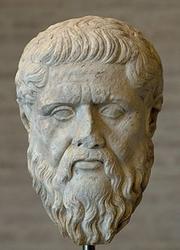
Plato was an Athenian philosopher who lived around 428 to 348 BC, one of the most influential thinkers in the history of the Western world.
A pupil of Socrates and, in turn, the teacher of Aristotle, he founded the Academy in Athens - among the earliest institutions of higher learning in the West - where he developed and taught the ideas later known as Platonism. Almost uniquely among great philosophers, he wrote not treatises but dialogues, dramatic conversations (usually led by Socrates) that remain as readable as they are profound.
Those dialogues include some of the foundational texts of philosophy: the Apology, Socrates' defence at his trial; the Republic, a sweeping enquiry into justice and the ideal state; the Symposium, on the nature of love; the Phaedo, on the soul and its immortality; and the Timaeus, on the origins of the cosmos. Running through them is his celebrated theory of Forms - the idea that beyond the changing world of the senses lies an unchanging realm of perfect ideals, grasped only by reason.
His influence is almost impossible to overstate; the philosopher A. N. Whitehead famously remarked that the European philosophical tradition is best characterised as 'a series of footnotes to Plato'.