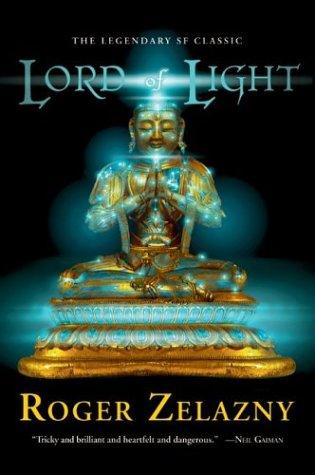
On a distant planet colonised long ago by the crew and passengers of a starship, the first generation has used mind-transfer technology and bodily enhancement to make themselves effectively immortal, cycling their minds into fresh bodies down the centuries and installing themselves as the gods of the Hindu pantheon, ruling the descendants of the ship's ordinary people as a jealous elite. One of the first, a man known most often as Sam, short for Mahasamatman and reluctant to claim the whole of a god's name, rejects this arrangement, holding that the technology of rebirth should belong to everyone rather than a divine aristocracy. To wage his long insurgency he revives the teachings of the Buddha, adopting the guise of an enlightened one to loosen the gods' grip on the minds of their subjects. Zelazny tells the story in a deliberately non-linear frame and in prose that swings between the mythic and the wryly modern, its wit doing much of the philosophical work. Peopled by figures such as Yama the god of death, the goddess Kali, Kubera and Ratri, the novel is finally a fable about power dressed as religion, and about whether liberation can be imposed from above.