A curated selection of book series and their reading orders. Open any to see the order to read them in, where each book fits, and what to read next.
Larry McMurtry
Larry McMurtry's four novels of the Texas frontier, following Woodrow Call and Augustus McCrae from young Rangers to old men. The cattle drive of Lonesome Dove came first and won the Pulitzer Prize in 1986; McMurtry then wrote forward to the pair's last years in Streets of Laredo before turning back to their beginnings in Dead Man's Walk and Comanche Moon. The result is a series best read either way round: publication order follows McMurtry's own change of mind about where the story lay, while chronological order runs from the 1840s to the 1890s and turns four novels into one long account of a frontier closing.
4 books
J. R. R. Tolkien
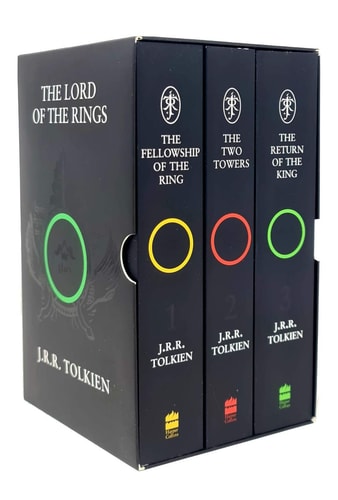
The defining work of epic fantasy. Gandalf arrives in the Shire to tell the hobbit Frodo Baggins that the ring his uncle left him is the One Ring - the instrument through which the Dark Lord Sauron once controlled the free peoples of Middle-earth, and that Sauron's servants are already hunting for it. What begins as a journey to get the Ring out of the Shire becomes a war for the survival of everything. Tolkien built Middle-earth over decades - its languages, histories, and mythologies existed before the story did - and the depth of that foundation gives the trilogy a gravity that most fantasy can only gesture toward. The Lord of the Rings didn't invent the genre but it set the terms under which most of it still operates.
3 books · Middle-earth
Rick Riordan
Magnus Chase dies on his sixteenth birthday and wakes up in Valhalla. From there he is drawn into Norse mythology, a world of einherjar warriors, Valkyries, frost giants, and a countdown to Ragnarok that may already be unstoppable. Set in Boston and the Nine Worlds of Norse cosmology, this trilogy brings a new voice and a new mythological system into the Riordanverse. Magnus is the cousin of Annabeth Chase, which connects the series to the Greek world, but the Norse mythology operates on its own terms and the series stands alone.
3 books · Riordanverse
Steven Erikson
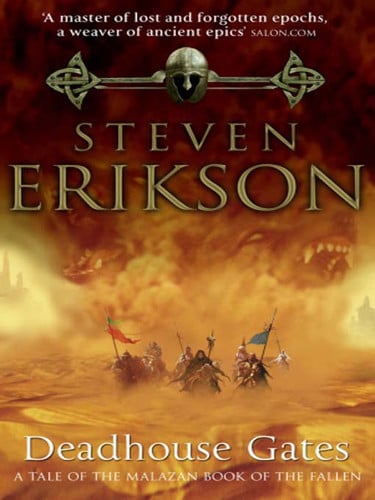
One of the most ambitious works in epic fantasy, the Malazan Book of the Fallen follows the campaigns of the Malazan Empire and the forces that resist, survive, and outlast it across multiple continents and thousands of years of accumulated history. The series is told from dozens of perspectives - soldiers, gods, assassins, ancient races, and ordinary people caught in the machinery of empire - with no single protagonist anchoring the whole. Characters disappear for entire volumes before resurfacing changed; events whose significance is obscure in one book resolve into clarity three books later. The series is notable for its deliberate refusal to explain itself. Gods, warrens, ancient races, and historical cataclysms are presented without preamble, trusting the reader to accumulate understanding gradually. This makes the opening books among the most demanding entry points in the genre and the later books among the most rewarding. The Malazan Book of the Fallen rewards patience and rereading in ways that few series match. The ten-book sequence concludes with Dust of Dreams and The Crippled God, written and published as a single narrative split across two volumes.
10 books
Stieg Larsson
Stieg Larsson's Millennium trilogy follows Lisbeth Salander, a brilliant and damaged hacker, and Mikael Blomkvist, an investigative journalist, through three novels of Swedish crime fiction that redefined the genre internationally. The series is known for its unflinching portrayal of violence against women, its meticulous procedural detail, and Salander herself - one of the most distinctive protagonists in contemporary crime fiction. Published posthumously, Larsson died in 2004 before seeing their success. The series has been continued by David Lagercrantz with four additional novels (The Girl in the Spider's Web, The Girl Who Takes an Eye for an Eye, The Girl Who Lived Twice, The Girl in the Eagle's Talons), though these are typically treated as a separate continuation rather than part of the original trilogy.
3 books
Brandon Sanderson
The original Mistborn trilogy introduces readers to a world of ash and mist, where a seemingly immortal tyrant has ruled for a thousand years and the skaa live as slaves beneath noble oppression. This is where Brandon Sanderson's Cosmere begins for many readers - a complete, self-contained story that showcases his signature magic systems and intricate plotting. Allomancy, the magic of burning metals for supernatural powers, drives both the action and the mysteries at the heart of these books. Follow Vin, a street urchin who discovers she's Mistborn - capable of using all Allomantic metals - as she's recruited into a crew planning the ultimate heist: overthrowing the Lord Ruler himself.
5 books · The Cosmere
Brandon Sanderson
Three hundred years after the events of the original Mistborn trilogy, the world has industrialised. Elendel is a city of railways, electric lights, and political corruption, where the heroes of the old age have hardened into religion and legend and the houses that rule the basin have largely forgotten what their world cost. Waxillium Ladrian spent twenty years as a lawman in the Roughs before being dragged back to the city to save his house from bankruptcy. He brings his irreverent partner Wayne, a talent for violence, and a set of Allomantic and Feruchemical abilities that make him uniquely suited to the conspiracies he keeps stumbling into. The four books blend the epic fantasy foundation of the original trilogy with detective noir and a genuinely funny double act at their centre.
4 books · The Cosmere
Terry Pratchett
Moist von Lipwig is a cheat, a swindler, and a conman - so he's the natural choice whenever an ailing institution needs new management. With a taste for flashy suits and even flashier publicity stunts, he takes on some of the worst jobs on the Disc and battles even bigger crooks than himself. Going Postal puts him in charge of the defunct Ankh-Morpork Post Office, Making Money hands him the Royal Bank, and Raising Steam sees him overseeing the development of the railway. The three books chart the Disc's industrial modernisation, with Moist as the reluctant engine of progress, always one step ahead of exposure. Lord Vetinari looms large as the puppet master behind each appointment.
3 books · Discworld
Arthur Conan Doyle
The four Sherlock Holmes novels form the structural backbone of the canon, introducing the universe's central characters and establishing its most substantial plots. A Study in Scarlet presents the first meeting of Holmes and Watson and sets out the consulting detective's method in full; The Sign of Four deepens their partnership while introducing one of the canon's more personally consequential cases; The Hound of the Baskervilles, the most celebrated and self-contained of the four, sends Holmes and Watson to the Devon moors for the canon's most atmospheric investigation; and The Valley of Fear, the final novel, returns to the theme of organised crime and secret societies that runs through the earlier work. The novels reward reading in publication order but The Hound of the Baskervilles functions as a natural entry point for newcomers encountering Holmes for the first time.
4 books · Sherlock Holmes
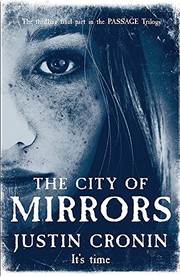
Justin Cronin
Justin Cronin's trilogy begins with a military virus trial that empties America and ends a century later with the last survivors deciding whether the world can be taken back. The first book moves from a near-future thriller to a post-collapse road novel and then to something closer to epic, and the two that follow keep widening the timeframe rather than tightening it. Written on a promise to Cronin's daughter that the heroine would be a girl who saves the world, it is horror in shape but unusually interested in what people rebuild afterwards.
3 books
Rick Riordan
Percy Jackson is twelve years old, has been kicked out of every school he has ever attended, and has just found out that his father is Poseidon. Camp Half-Blood, a training ground for the children of Greek gods hidden in Long Island, is both a refuge and the beginning of something much larger. Over five books Percy grows from a confused kid who can breathe underwater to the demigod at the centre of a prophecy that will determine the fate of Olympus. The original series that launched the Riordanverse, built around a voice so distinct and a mythology so confidently reimagined that it created its own genre of modern mythology fiction.
5 books · Riordanverse
Robin Hobb
Four novels set in the Rain Wilds following a group of misfit dragon keepers and their damaged charges on an expedition to find the lost Elderling city of Kelsingra. The Rain Wild Chronicles is the most adventure-driven strand of the Elderlings sequence and the most directly concerned with the dragons and the ancient Elderling civilisation that underlies the universe's mythology. Thymara and Alise Finbok are its central characters, and the series deepens the Liveship Traders' world considerably while standing relatively independently of the Fitz narratives.
4 books · Realm of the Elderlings
Pierce Brown
Darrow is a Red, the lowest caste in a colour-coded hierarchy, mining beneath the surface of Mars in the belief that he is making it habitable for generations to come. When he learns that Mars was terraformed long ago, and that his people are a slave class kept underground on a lie, he is surgically remade as a Gold and sent to infiltrate the elite that rules him. Pierce Brown's first three novels carry him from a brutal training school for young Golds to open war across the solar system, trading the tight arena of the first book for something closer to a war epic. The saga has continued beyond this trilogy.
3 books
Pat Barker
Pat Barker's First World War trilogy opens with Siegfried Sassoon sent to Craiglockhart War Hospital in 1917, not because he is ill but because he has publicly declared the war a deliberate prolonging of suffering. The doctor assigned to him, the anthropologist and psychiatrist W.H.R. Rivers, has to decide what curing a man can mean when recovery returns him to the trenches. Real figures move alongside the invented Billy Prior, a working-class officer through whom the trilogy examines class as closely as it does shell shock. The Ghost Road won the Booker Prize in 1995.
3 books
Terry Pratchett
Rincewind is the Disc's most useless wizard - he can't even spell "wizzard," and his most notable talent is running away very fast. Beginning with The Colour of Magic, these were Pratchett's earliest Discworld novels, initially written as parodies of fantasy before evolving into broader satire. The other wizards of Unseen University aren't much better, spending more time studying the common room biscuit tin than mystical tomes, though they occasionally stretch to some magic between elevenses. Across eight books, Rincewind is dragged into adventures spanning the entire Disc - from the Counterweight Continent to ancient civilisations to XXXX - while the Unseen University faculty, led by Archchancellor Ridcully, provide a recurring ensemble. Unseen Academicals shifts focus almost entirely to the university itself. The series establishes much of Discworld's cosmology, geography, and the Luggage - Rincewind's homicidal travelling companion.
8 books · Discworld
Leigh Bardugo
Alina Starkov is a mapmaker's assistant in the Ravkan army when she discovers she is a Sun Summoner: a Grisha with the rarest power in the world, one that could destroy the Fold and reunite the kingdom. Brought to the Little Palace to train under the Darkling, the most powerful Grisha alive, she begins to understand that power this rare attracts attention of a particularly dangerous kind. A trilogy about the cost of being extraordinary in a world that wants to use extraordinary people, and about whether the promise of salvation is ever worth the price attached to it.
3 books · Grishaverse
Arthur Conan Doyle
Fifty-six stories published across five collections between 1891 and 1927, originally appearing in The Strand Magazine before being gathered into the volumes that define the canon's short form. The collections span the full arc of Doyle's relationship with his creation - from the sharp, inventive work of the Adventures and Memoirs through the resurrection of the Return, the valedictory tone of His Last Bow, and the uneven final cases of the Case-Book. Each collection is distinct in period, quality, and tone, and together they contain the majority of the canon's most celebrated cases, its most significant character appearances, and its most consequential plot developments.
5 books · Sherlock Holmes
Leigh Bardugo
Ketterdam is a city built on trade and crime, where the Merchant Council looks the other way and the gangs run everything below the surface. Kaz Brekker, the most feared teenager in the city's most powerful gang, is offered a job that should be impossible: break into the most secure prison in the world and extract a hostage worth more than any of them can imagine. He assembles a crew of specialists: a convict, a sharpshooter, a runaway, a spy, a Grisha. A duology that runs parallel to the events of Shadow and Bone, set in a different country with a different tone: darker, funnier, and more interested in what loyalty costs when everyone involved has reasons to betray everyone else.
2 books · Grishaverse
William Gibson
The Sprawl is William Gibson's interconnected fictional setting spanning his landmark cyberpunk trilogy and several short stories from the 1980s. The name refers to the Boston-Atlanta Metropolitan Axis, a vast urban corridor stretching along the eastern seaboard of a near-future United States, though the stories range across the globe and even into orbital space. The universe is defined by its vision of a hyper-connected, corporate-dominated world where hackers jack into cyberspace - a shared digital hallucination - while street-level hustlers navigate a gritty, technology-saturated underworld. Megacorporations wield more power than governments, artificial intelligences push against the limits of their constraints, and the line between human and machine blurs through cybernetic modification. Gibson's Sprawl stories are widely credited with defining the cyberpunk genre and introducing concepts - cyberspace, ICE, the matrix - that shaped how an entire generation imagined the digital future.
4 books
Brandon Sanderson
Roshar is a world scoured by highstorms - massive, recurring tempests of such power that its ecology, architecture, and culture have all formed around surviving them. The magic comes from those storms: Stormlight, breathed in to fuel the Surgebinding abilities of the Knights Radiant, an ancient order that protected humanity for millennia before mysteriously abandoning their oaths and disappearing. The series follows Dalinar Kholin, a highprince haunted by visions of the past, Kaladin, a former slave who becomes a soldier and then something more, and Jasnah, a scholar-queen who suspects the Return of the ancient enemy is already underway. Brandon Sanderson's most ambitious work - planned as ten books, with five published - and the centrepiece of the Cosmere.
7 books · The Cosmere
Robin Hobb
Set fifteen years after the conclusion of the Farseer Trilogy, the Tawny Man follows an older Fitz drawn reluctantly back into the world of Buckkeep and its politics. The reunion with the Fool is the emotional heart of the trilogy, and Hobb uses the passage of time and the weight of the first trilogy's events to examine what survives of a person after they have given everything once already. The Tawny Man is generally regarded as the finest of the Elderlings trilogies for the maturity and emotional precision of its character work.
3 books · Realm of the Elderlings
Hilary Mantel
Hilary Mantel's trilogy follows Thomas Cromwell from a blacksmith's yard in Putney to the closest position of power in Henry VIII's England, and then to the scaffold. Written in the present tense and held tight to Cromwell's point of view, it reads the Tudor court from the inside out: a self-made administrator watching men born to rank make ruinous decisions, and quietly outlasting them until he does not. Wolf Hall and Bring Up the Bodies each won the Booker Prize, making Mantel the first author to win for a novel and its sequel, and The Mirror and the Light completed the trilogy in 2020.
3 books
Terry Pratchett
Tiffany Aching is a young witch, social worker, and cheese maker extraordinaire. She hails from a long line of shepherds and has a powerful connection with the Chalk where she lives. Wherever Tiffany goes, it's almost certain that a horde of tiny fighting, drinking blue men in kilts - the Nac Mac Feegle - won't be far away. The five books follow Tiffany from age nine through to young adulthood, each dealing with a different stage of growing up and learning what it means to be a witch. The series connects back to the Witches sub-series, with Granny Weatherwax serving as Tiffany's mentor. The Shepherd's Crown, the final Discworld novel, serves as a conclusion to both Tiffany's story and the series as a whole.
5 books · Discworld
Rick Riordan
Zeus has punished Apollo by casting him out of Olympus as a mortal teenager with no powers, no godly authority, and a body he finds deeply inadequate. To regain his place among the gods, Apollo must serve the demigod Meg McCaffrey and find and free a series of ancient Oracles scattered across America, each held captive by a different Roman emperor brought back from the dead. Five books that use Apollo's enforced mortality and his long history of careless cruelty as the basis for a genuine redemption arc, set against the largest and most politically complex threat the Riordanverse has faced.
5 books · Riordanverse